Sunday, July 1, 2012

Fun Facts – Groningen

1. In 1870, the St. Paul and Duluth Railroad crossed Pine County, and railroad men established a flag stop and section house at Miller Station. Three years later, the first operator, hunter and trapper William Jacob, began his work. He was the only resident in the area.

2. In the 1880s, a few setters, including section foreman John Haglin and his brother Severt, moved to Miller Station. The Brennan Lumber Co. began logging nearby in 1887.

3. A railroad depot was moved from Sandstone Junction to Miller Station in 1890, and operator Mr. Thompson relocated his family to the tiny village. Andrew Hansen also settled just southeast of Miller Station.

4. During the 1894 fire, all the residents of Miller Station survived. They even managed to save the section house by hauling muddy water up from a slough, but the depot burned.

5. Beginning in 1895, St. Paul and Duluth Railroad officials hired Theodore F. Koch to sell railroad land in Pine County. Koch, who received a 20% commission from land sales, worked hard to bring settlers into the area. A group of Hollanders soon settled at Miller Station, purchasing land for $4 to $5 per acre and renaming the village “Groningen” after their hometown in Holland.

6. Groningen's first school was held at Severt Haglin's home in 1896. There were seven students: George and Arthur Haglin, Waldie and Ollie Erickson, John Sundeen, Peter Bjorklund, and Edwin Erickson. Miss Lenore Erickson of Sandstone was the teacher. The schoolhouse was built the following year, received an addition in 1908, and was replaced by a two-room school in 1915.

7. Theodore Koch's land company built a large, two-story hotel in Groningen in 1897. The lumber came from dead trees pulled from Miller Lake. Koch also founded a saw mill and turpentine processing plant.

8. Groningen residents celebrated a new century when they gathered at the schoolhouse at 8 p.m. on December 31, 1899. They built a bonfire out of barrels of straw soaked in kerosene and made a sign with 1899 on one side and 1900 on the other. Everyone cheered at midnight and greeted the midnight passenger train with loud cries of “Happy New Year!”

9. By 1918, Groningen was home to two general stores, one of which was A. Erickson's Groningen Mercantile; A.C. Haglin's garage; three cream buyers; a potato warehouse; some blacksmith shops; the hotel; a barber shop; and the bank, where W.H. Erickson served as cashier.

10. Like many small towns, Groningen struggled to maintain its population and business community. In 1954, the post office closed. The general store and bank followed in 1955 and 1956, respectively. Today, Groningen is another Pine County ghost town.

Sources: Pine County...and Its Memories by Jim Cordes; information from Helen Haglin and William Erickson; timeline from Sandstone History and Art Center


The Groningen depot


One of Groningen's stores

Sunday, June 24, 2012

Hustling Beroun


From The Pine County Pioneer, March 18, 1898

Beroun, six miles north of Pine City, on the St. Paul and Duluth R.R., is the post office and village point for a country that is being rapidly developed and quickly settled. In 1897, 6,000 acres were sold in this vicinity and there will be a big immigration this spring. A dozen families are expected this week and for the season it is confidently believed that the population will increase fifty per cent.

Two years ago Joseph Chalupsky came to Pine county on business and after looking it over and seeing the clover and timothy growing spontaneously concluded to come here and go into the stock business. He bought 800 acres of land, 160 of which he platted and has sold fifty lots. He also started a mercantile house, and in real estate business has 30,000 acres on his lists. He is a native of Bohemia – came to this country in 1870, and from New Prague here in 1896, as many more citizens of this belt of country did. Mr. Chalupsky is a prominent man in more ways than one as he is Supreme President of the Catholic Union, which has 13,000 members, and he is Supreme Treasurer of the Catholic Workmen.

F. Warlieck also came here two years ago. He owns a farm with 80 acres of splendid meadow two miles from town and he has a general store therein and ships wood and produce. He came here from St. Paul, where he was a noted cabinet maker and builder and is putting substantial buildings on his place.

Beroun has a railway station, two stores, a hotel, post office, blacksmith shop, public school and Roman Catholic Church.

C.H. Furman is also a real estate man and has just returned from Washington state.

John Shilkr is the blacksmith and postmaster and he hardly knows a word of English.

Joseph Chalupsky has handled over 2,000 cords of wood up to date, and his lumber yard will be well patronized this and following months.

The Beroun railway station is admirably conducted by Horace Wilcox, a member of a pioneer family of Pine county. He was brought to this region in 1869, and was born in Sunrise over in Chisago county. For sixteen years he has been a disciple of Morse, and for fourteen, as agent at points on the St. Paul and Duluth.

The timber lands and meadow lands in this region are cheaper than will be six months from now.

Sunday, June 17, 2012

Big Danish Settlement

From a Pine County newspaper, January 19, 1906:

The Townsite of Partridge Selected as Homes for a Large Number of Thrifty Danes

With the passing of time Pine county land is receiving much favor from parties who are in search of money-making real estate. Nearly all of Pine county soil is rich enough for the abundant growth of anything adapted to this climate. On this account a company, known as the Dansk Folkesanfund, has purchased the entire townsite of Partridge, and has taken the agency to sell an optional 15,000 acres of land belonging to the Farmers' Land & Cattle Co.

The company is preparing to colonize the tract of land just purchased with a settlement of Danes, who will build houses and till the soil and do good for themselves and the county. The erection of a church and a church school is contemplated and a town may be started at an advantageous point in the settlement. The farms and roads will be improved with the advent of time, and the Danes, who will cast their lot in Pine county, will undoubtedly prosper, for they are a thrifty and industrious class, as is proven by other thriving settlements throughout the state.

To illustrate the desirability of Pine county land we quote the following from the Sandstone Courier which contains a good account of the deal represented in this article.

“Some time ago they decided that they had enough settlers at Tyler, and that they would secure more land for another settlement in this state. They selected a committee of three, composed of K.H. Duus and L.C. Pedersen, of Tyler and A.H. Jurgenson, of Menomonee, Mich., to thoroughly search the state for the most desirable location. They went to Wadena, Bemidji, Solway and Cromwell and carefully examined the counties of Beltrami, Hubbard, Itasca, Aitkin, St. Louis, Carlton and Pine. After careful consideration, they decided that Pine county is the best suited for their purpose and that the most desirable land could be secured here at reasonable figures. They also gave as a reason that it is the best location in the state for marketing their produce as it is midway between four of the largest cities of the Northwest.”

Monday, June 11, 2012

Fun Facts – Bruno – Part 2

1. The State Bank of Bruno was incorporated in 1910 and opened for business on June 1. Early shareholders included J.H. Lingren, Fred Jesmer, W.H. Rowcliff, E.E. Jesmer, and M.W. Tuttle. J.H. Lingren served as cashier and Will Ames as assistant cashier. The bank moved into a brand new, modern, fireproof building in 1912.

2. Bruno received a new school in 1915 after the current building (built in 1904) was condemned by the state. The new school cost $15,000 and served students in Kindergarten through twelfth grade.

3. The Bruno Cornet Band organized in 1915 when a group of interested musicians met at the Didden barber shop. Band members John Didden, H. Lund, R. Lund, Ralph Williams, Albert Fairchild, Elton Bigelow, Ray Fairchild, Edwin Fairchild, Floyd Fairchild, Sylvester Marihart, J.C. Anderson, Tommy Rodenberger, William Sague, and D.C. Holst immediately started practicing. Apparently they experienced a few difficulties at first because some Bruno residents reported “agonizing noise” coming from the practice room, but the band gave its first concert in June.

4. The village of Bruno was spared during the great forest fire of 1918, but several Bruno-area families lost their homes and farms to the blaze, which killed over 450 people in Carlton and Pine counties. Near Bruno, Ray Fairchild died along with his wife and son. The wife was trapped in the family home and died there. Mr. Fairchild and his boy tried to escape the fire but were badly burned and died a few days later.

5. In 1919, school superintendent Mr. Cook bought a moving picture machine, and the movies came to Bruno! Community members enjoyed such early silent films as Carmen and Mary Pickford's Rags.

6. One hundred Bruno farmers got together on April 1, 1920, to organize the Farmers' Cooperative Creamery. Farmers purchased one $10 share of the creamery for each cow they owned, and $2,500 was raised that day. The group elected the following officers: Nels Lindh, president; E.J. Rodenberger, vice-president; and I.B. McNelly, secretary-treasurer. Creamery directors were Fred Matthews, W.M. Plaisted, Louis Lindstrom, and A.L. Churchill. Otto Pearson received a construction contract for the creamery in October, but it was not open for business until 1923. Mr. Muffet was the butter maker.

7. By 1921, Bruno's business community included three general stores, a garage, a lumber yard, a feed and seed store, a farm machinery dealer, a lath mill, a blacksmith, a harness and shoe shop, the creamery, and the bank.

8. Beginning in 1931, Bruno had its own newspaper, Pine County Beacon. It was printed in Markville and featured news from Bruno and Kerrick.

9. In November of 1937, robbers made off with $2,500 from the State Bank of Bruno. Apparently, the thieves were professional about their work, for they robbed the bank in the middle of the night and poured water into the safe so the paper money would not be destroyed as they burned a large hole in the safe with a torch. In January of 1938, the bank installed a burglar alarm.

10. Bruno began to decline in the 1940s and 1950s. The Bruno school lost its high school program in 1947 when students were sent to Askov instead. Two stores, the Markus general store and Andy Traxler's Fairway store, burned in March of 1950. The creamery dissolved in August of 1951, and the bank closed the next year.

Sources: Courage in a Rugged Land by Edna Bjorkman and Robert David Olson; Pine County...and Its Memories by Jim Cordes


Bruno in 1908

Monday, June 4, 2012

Introducing...

Images of America: Kanabec County!


From the back cover:
"Featuring 217 historic photographs, Images of America: Kanabec County guides readers on an exciting journey into the past as it explores the daily lives of the people who helped make Kanabec County in East Central Minnesota what it is today. Each chapter examines a unique aspect of Kanabec County’s history. Readers meet Native Americans, settlers, and loggers from the county’s earliest days; learn about early government, industries, and transportation; catch a glimpse of towns and villages in the nineteenth and early twentieth centuries; go on a shopping trip with county residents; discover the fascinating histories of area schools and churches; and find out what Kanabec County people did for fun in the days before television and computers."

Images of America: Kanabec County is available at Kanabec History Center and Dandelion Floral in Mora, Minnesota, and online at Amazon.com.

Sunday, May 27, 2012

Fun Facts – Bruno – Part 1

1. The Great Northern Railroad was completed through Pine County in 1887. The railroad established numerous stations including one named Mansfield Station. Settlers were already moving into the area by this time, including the Doyle brothers, Jimmy, Jack, and Mike. The Doyles sold food and drink to loggers who worked at local camps, but the brothers were a pretty tough bunch. They allegedly liked to put knockout drops in their customers' drinks and then relieve them of their money.

2. By 1894, most of the residents of Mansfield Station were associated with the railroad or the lumber industry. R. L. Saunders was the telegraph operator. William Nestler, the section foreman, lived in Mansfield with his wife, Annie, and their children. Pete Peterson and Matt Hands were section crewman, and the Tozer and Barter Logging Company had opened a warehouse to store their supplies.

3. In 1895, the Empire Logging Company constructed the Fleming Logging Railroad that began just southeast of Mansfield Station. The railroad transported logs from Pine County lumber camps to the Yellow Banks landing on the St. Croix River. The railroad was discontinued in 1898 or 1899 and became a wagon road around the turn of the century.

4. Mansfield Station received its post office on April 10, 1896. It operated out of the Tozer and Barter warehouse.

5. In 1898, the railroad changed the little village's name from Mansfield to Bruno because there was already a Mansfield Station elsewhere in Minnesota. No one knows for sure how the village got its new name. It might have been borrowed from French hotel proprietor and logging company owner Bruno Vinette. It may also have been a corruption of the German word for “bear.” A local saloon kept live bears for the amusement of its customers, which included German loggers.

6. Bruno's first schoolhouse, a 10 x 12 foot structure, was built in 1901. The school population soon outgrew it, and a new, larger school was built the following year. Bruno's school district, #54, was also organized in 1902.

7. The Bruno town site was platted in 1902 by Fitzhugh Burns, and the village was officially incorporated on September 10, 1903. Town officers were L.A. Buswell, village council president; A.O. Wharton, J.H. Alexander, and H.E. Crane, trustees; L.C. Klug, treasurer; J.H. Alexander and A.O. Wharton, justices of the peace; and W.H. Gellatly and Pat Murphy, constables.

8. The new village council got busy immediately and passed the first ordinance. It regulated the local saloon and specified the following: “The saloon interior be visible from the street at all times, with a light burning all night. No minors allowed in the saloon. The saloon be closed Saturday at 11:00 p.m. and not opened until Monday morning. No liquor sold during the hours the saloon was required to be closed.”

9. The first white child born in Bruno, William Gellatly, Jr., arrived in December of 1903. Another child, William Marihart, was born in January of 1904.

10. By 1904, Bruno was a bustling village. Businesses included the Marihart and Nelson sawmill, a shingle mill, John Stafford's general store, a meat market, a saloon, Pat Murphy's livery barn, the Bruno Farmers' Produce Company, and the Farmers' Land and Cattle Company. The village could boast of boardwalks, four kerosene street lamps, a new “lock-up” managed by village marshal Andrew Nelson, a new two-room schoolhouse, and two churches (Catholic and Presbyterian). Fitzhugh Burns donated the land for the two churches, and the Farmer's Land and Cattle company, managed by Pat Murphy, donated $500 toward the construction of each.

Sources: Courage in a Rugged Land by Edna Bjorkman and Robert David Olson; One Hundred Years in Pine County; Pine County...and Its Memories by Jim Cordes; Askov American newspaper, July 1, 1976

Sunday, May 20, 2012

Bad Fire at Sandstone

From a December 7, 1922, newspaper:

A bad fire occurred at Sandstone last Friday night, when the Webb Hardware store and the garage adjoining the First National bank was completely destroyed by fire. The interior of the bank was badly damaged by smoke and water, and the Masonic hall, over the bank, was practically ruined. The lodge furniture and equipment was burned and the room burned out.

The bank building is on a northwest corner facing the main street. The garage adjoins the bank building on main street and the store building faces the side street, back of the bank and garage.

The fire was discovered in the evening about 11:30 in the rear of the hardware store building. Its origin is unknown. The hardware store burned to the ground and is a total loss, as was the garage building. Four or five cars stored in the garage were also destroyed.

The building that houses the Sandstone Courier printing plant is near the garage with a vacant lot between. The Courier building caught fire but it was extinguished before much damage was done by fire, although machinery and type was damaged by some water.

The bank and garage buildings were built by the late Alexander McEachern between 25 and 30 years ago, who operated the old Superior hotel in what was the garage building, which was then two stories and had a store in the other building.

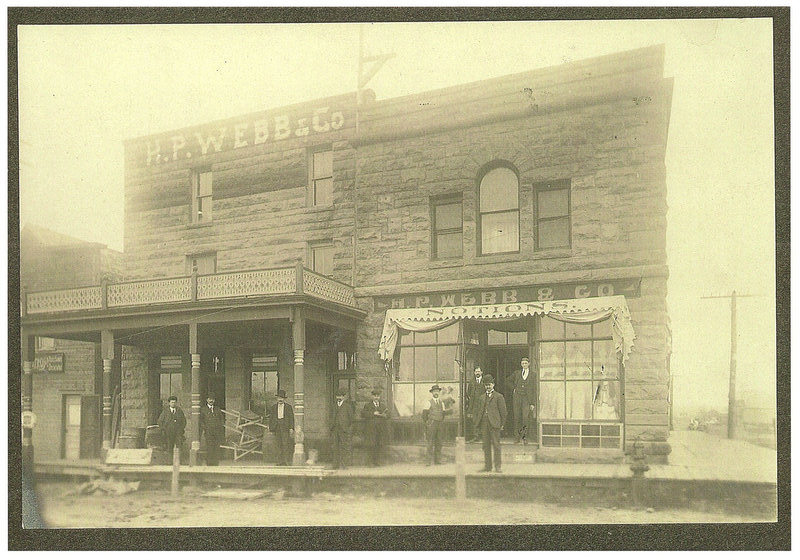
H.P. Webb & Co. once occupied these two adjoining buildings on the northeast corner of Main Avenue and Fourth Street in Sandstone.

After 1906, H.P. Webb & Co. was located in the wooden building behind the sandstone structure on the corner.  

 Sandstone State Bank purchased the corner building from H.P. Webb & Co. for $5000 in 1906.  Later it became First National Bank.  Notice the adjoining sandstone building on the left and the wooden H.P. Webb & Co. store in the back.

The First National Bank was not completely destroyed by the 1922 fire, but the buildings to its side and rear were.  The bank building was remodeled.  Today it is home to Sandstone History & Art Center.