Friday, December 20, 2019

The Village of Sandstone


The building of Sandstone is coeval with the quarry. At first it was two tents, then a log boarding camp and hovels, and a few scattered buildings near the spring in the ravine south of the quarry. Only one family remained over the summer of 1886, the remainder having removed to Sandstone Junction. With the completion of the Kettle river railroad, people connected with the quarry built houses and brought their families here. A post office was established in January, 1887, and W. H. Grant, Jr., was commissioned postmaster. In May following, the townsite of the old town was platted by the Sandstone Townsite Company, numerous lots were sold and building progressed rapidly. The building of the Eastern railway of Minnesota in 1888, for several months, made Sandstone by far the liveliest town in the county. A fine system of water works were constructed, two commodious hotels opened, and many business and houses were added to the already prosperous town. In February 1889, the village was incorporated and its officers elected. On the day of the annual election William H. Grant, Jr., was elected president of the village council, and his successors have been as follows: Michael Ring, Albert L. Glasow, J. E. Erickson, Christ Heisler, Jr., Peter Peterson, F. L. Dennie, Angus Gunn, H. P. Webb. In 1890 the population was 517; 1895, 1054; 1899, 1800. In October, 1894, the plat of Sandstone Quarries was filed by the Minneapolis Trust Company, and then commenced the rebuilding of Sandstone.

Sandstone's Gift Souvenir...c. 1899


While this photo is not original to the Sandstone Gift Souvenir, it was taken not long afterward and shows a very similar scene.

Monday, October 14, 2019

"First Opening of the Quarries" written by Col. W. H. Grant


No history of the opening or development of the stone quarries at Sandstone has ever been written. Space here forbids anything but a meager outline.

The first opening was made on the river bank about two hundred feet south of the present quarry office, August 22, 1885. At that time the river bank, the bluffs and in fact the whole region was thickly covered with timber and a heavy growth of underbrush. This opening was made by the writer, no other person being then interested in the enterprise. The crew consisted of Daniel Ryan, foreman, John McCoy, Michael McNamara, and John Randal, quarrymen, Orville C. Cox, blacksmith, Michael Logue, cook, and Joseph Thomas, Henry Mapes and James Campbell, lumber jacks, for cutting brush. This crew remained for ten days, two or three days of which were too rainy for work. The first picture of the quarry was taken some weeks later showing however the only opening made and its condition, when the crew was discharged. The stone at the upper right corner, was the first cut in the quarry. During the progress of this work four loads of stone were hauled by team to Hinckley and shipped to St. Paul. Col. R. A. Smith having the honor of hauling the first load and Leavitt Reynolds the second. One large block was sawed by Lauer Bros., and the remainder cut by Matt Breen at his sheds on Court square, St. Paul, and all exhibited at the state fair, where they attracted much attention.

For the purpose of introducing the stone the quarry was opened during the following winter, giving employment to about thirty men, and 232 car loads were quarried, hauled to Sandstone Junction, and from there shipped to St. Paul, Minneapolis and Stillwater, during the summer of 1886. Meantime the Kettle river railroad was constructed from the quarry to the St. Paul & Duluth track and shipments of stone commenced December 1, 1886.

About November 1, 1885, John P. Knowles became a partner with the writer in the enterprise and so remained until the quarry was finally sold. In December, 1886, the Kettle River Sandstone company was incorporated with a capital stock of $200,000, the stock of which was owned by the writer, John P. Knowles, Fred A. Hodge, James Hurley, and W. H. Grant, Jr. This company never operated the quarry, but soon after leased it to Ring & Tobin, who erected a four gang sawmill and operated the quarry extensively until it was closed on account of the panic in 1893. During 1887, 1888, and 1889, the quarry was worked on a large scale, often giving employment to more than four hundred men. The great fire of September 1, 1894 having destroyed the mill and all other property in the quarry except the office and powder house, The Minnesota Sandstone company succeeded to all other interests. The present capital stock of the company is $100,000. It gives steady employment to three hundred and fifty men, and last year shipped two hundred and ninety car loads of stone. The shipments for the first six months of the present year have been one thousand seven hundred car loads.
Sandstone's Gift Souvenir...c. 1899

Tuesday, October 8, 2019

Lost Communities in Pine County, Minnesota, Part 5


Researched and written by LaJune Troolin

Sand Creek Community - Sandstone Township, east of Sandstone - After logging operations stopped, Kock & Company of Chicago bought up miles of land and started advertising that the land would be perfect for farming. Scandinavians began to buy up the land and formed a small community around Sand Creek. The first school was held at Svardal's home until a school could be built in Section 11.

How the Community of Sand Creek Began by Holger Larson

Sandstone Junction - Dell Grove Township, Section 18 - To be able to haul rock from the quarries in Sandstone, a railroad spur was built from the quarries to about four miles west of Sandstone at a little place called Sandstone Junction. Here the spur connected to the main railroad line. Sandstone Junction had a train station, hotel, general store, and school.

Sandstone the Quarry City-page 51

Silverton Village - Park Township, Section 27 - This was a platted village for the Arrow Line Railroad, and a hotel was built with the understanding that there would be traffic from the railroad coming through.

Pine County and its Memories-page 322

Springdale Community - Arlone Township, Sections 23-24 - A small community of settlers came here because of the rich farm land that was advertised in this area.

Minnesota Place Names-page 445; Pine County and its Memories-page 296

Stage Stop - Pine City Township, Section 11 - This stage stop was on the old government road.

One Hundred Years in Pine County-page 144

Tuxedo (Bergman) - Pokegama Township, Section 26 - Tuxedo Inn was a very popular resort on Pokegama Lake. It had a ballroom, and well known orchestras often performed there. A post office was established at the inn and was called Bergman from 1898-April 1905 and later became Tuxedo but discontinued in October 1905.

Minnesota Place Names-page 445; Pine County and its Memories-page 157

Villstad Community - Partridge Township, Section 4 - Swedish immigrants built a church in 1899 and named it Villstad after a village in Sweden, where they came from. A cemetery surrounds the church. The church and cemetery are still there and are well cared for.

Minnesota Place Names-page 445; Pine County and its Memories-page 184

Wareham Village - Sandstone Township, Section 21 - There was a station here of the Great Northern Railway.

Minnesota Place Names-page 445

Whalens Village - Keene Township, Section 21 - This was a proposed village for the Arrow Line Railroad.

Minnesota Place Names-page 445

Stage stop - Windemere Township, Sections 10-11 - This stage stop was on the old government road.

Pine County and its Memories-page 90

Glasspool - A post office was here between July and November 1905. No location can be found.

Minnesota Place Names-page 442

Mille Lacs - A post office was here between 1856 and 1859. The location has not been found but is possibly in Ogema Township.

Minnesota Place Names-page 443

Mortimer - A post office was established on February 19, 1889, with Thomas Creeper to be the postmaster. Some records show that he could have operated the post office until April. The location has not been found.

Minnesota Place Names-page 443

Saturday, October 5, 2019

Lost Communities in Pine County, Minnesota, Part 4


Researched and written by LaJune Troolin

Meadow Lawn Community - Chengwatana Township - There were a number of nationalities that settled in Meadow Lawn. They were hard working farmers, and their first homes were log homes. The first school house (section 10) was also made of logs, and about 1903 a frame building was built. 

One Hundred Years in Pine County-page 135; Pine County and its Memories-page 5

Midway Village - Mission Creek Township, Section 34 - Midway was platted just north of Beroun in 1855 by Frank and Julia Lewis but was never developed.

Minnesota Place Names-page 443; Pine County and its Memories-page 59

Milburn Community - Pine City Township, Section 32 - The earliest settlers, who were Swedish, came in 1885 to the Milburn area. It was a logging community, and in 1894 a lumber mill was started there. Milburn Community had two churches (Swedish Free Mission and Norwegian Lutheran), a school, and a cemetery.

One Hundred Years in Pine County-page 144; Pine County and its Memories-page 36

Mineral Springs - Finlayson Township, Section 8 - A brochure was found advertising a mineral spring with therapeutic qualities northeast of Finlayson. A company was formed, sold stock, and started planning a resort and health spa. There is evidence of structures and curbing, but nothing became of it, and the company was dissolved.

Pine County and its Memories-page 111

Mission Creek Village - Mission Creek Township, Section 10 - Most of the settlers in the village were Swedish, and it was considered a sawmill town. They had a sawmill, a railroad depot, a hotel, a general store, a post office (1876-1908), a blacksmith shop, a school, 26 houses, and a cemetery.

Minnesota Place Names-page 443; Pine County and its Memories-page 59

Morgan Stopping Place - Clover Township, Section 20 - Henry Morgan owned a livery stable and an inn in this stopping place. The township meetings were also held there. When Mr. Morgan left in 1906, James Dunphy took over the livery and inn and also operated a sawmill.

Pine County and its Memories-page 216; Then & Now in Clover-page 13

Neshodana Village - Arna Township, Sections 35-36 and Ogema Township Sections 1-2 - In 1856 this area was platted but never settled.

Minnesota Place Names-page 443; Pine County and its Memories-page 287

Otto Village - Park Township - This was a proposed village for the Arrow Line Railroad.

Pine County and its Memories-page 268

Pine Grove Community - Pine City Township - The Pine Grove Community was located in the center of the township about five miles southeast of Pine City. The old government road ran through this section of the county. The community was made up of mostly Swedish immigrants. At first they logged but stayed on to farm when the logging was finished. They had a church and two schools in the area.

One Hundred Years in Pine County-page 143; Pine County and its Memories-page 35

Friday, September 20, 2019

Lost Communities in Pine County, Minnesota, Part 3

Researched and written by LaJune Troolin

Fortuna Village - Finlayson Township, Section 11 - Fortuna was platted in January 1857 and was incorporated May 19,1857. It was to be the county seat for the new Buchanan County (May 1857- March 1861), which is now the northern part of Pine County. The investors believed the village would grow because of the stagecoach stop that was already there and with lumbering companies coming to the area. Fortuna had a hotel, and traces of other foundations that might have been businesses or houses have been found. The Rocky Dam Relay Station was on the site before Fortuna. It was a stagecoach rest stop that was built in 1855 for $5,000 and was owned by Burbank Merrian & Co. of St. Paul. Some have claimed that Fortuna was on the site that later became Sandstone, but it was not. Sandstone is actually about six miles farther south.

Sandstone the Quarry City-page 11; Pine County and its Memories-page 107

Friesland Village - Dell Grove Township, Sections 25 and 36 - In 1895 the Theodore F. Koch Land Company was hired by the St. Paul & Duluth Railroad to sell railroad land in Pine County. It started sending out advertisements to the Dutch communities of Holland about the great farming land in Pine County, Minnesota. Friesland was built to accommodate the immigrants that were coming from Holland. They had a number of businesses, a post office (1896-1917), and a railroad station.

Minnesota Place Names-page 442; Pine County and its Memories-page 96

Groningen Village - Dell Grove Township, Section 1 - Groningen started out with the name of Miller Station. The St. Paul and Duluth Railroad established a flag stop and section house in 1870 at Miller, and by 1890 a depot was moved there. A post office called Belknap was established (1877-1881) at Miller. After the 1894 fire the immigrants that were coming from Holland purchased land in and around Miller and changed the name to Groningen. The village had a number of businesses, a school, and a post office (1896-1913 and 1917-1954).

Minnesota Place Names-page 442; Pine County and its Memories-page 96

Harlis Village - Nickerson Township, Section 1 - The Soo Line Railroad had a depot at Harlis. The village had a school and a post office (1914-1932). There were also a few houses built around the depot. Nothing is left of the village now.

Minnesota Place Names-page 442; Pine County and its Memories-page 253

Holly Community or Center - Danforth Township, Section 21 on Fleming Road - This community was a staging center for loggers' supplies that were coming from Grantsburg, Wisconsin, and also a location for loggers to pick up their mail.

Pine County and its Memories-page 209

Hustletown Community - Chengwatana Township, Section 19 - There are a number of nationalities that settled near Hustletown. The community had a school and a church with a cemetery.

Pine County and its Memories-page 3; One Hundred Years in Pine County-page 135

Friday, September 13, 2019

Lost Communities in Pine County, Minnesota, Part 2


Researched and written by LaJune Troolin

Chengwatana Village (Alhambra Village) - Chengwatana Township, Section 26 at the point of were the Snake River leaves Cross Lake - The area around Chengwatana (Alhambra) had been inhabited for many years by an Indian village and later by trappers, traders, etc. The settlement was first platted in 1856 as Alhambra by Elam Greeley, Judd, Walker and Company, and before the ink was dry, a share was bought by Daniel Robertson (Robertson Company). In July 1856 Herman Trott became an agent for Robertson Company, and his first task was to plat a new town and call it Chengwatana. The Alhambra plat was set aside, and the new plat was made larger. In February 1857 Chengwatana became the first county seat for Pine County. The first county commissioners were Herman Trott, George Staples, and Royal Grey. The village had a school, post office (Alhambra 1856-1857; Chengwatana 1857-1873), court house, general store, hotel, blacksmith shop, sawmill, several houses, etc. When the train went through Pine City instead of Chengwatana, Pine City became the new county seat in 1872.

Minnesota Place Names-pages 440-441; Pine County and its Memories-page1; Who's Who in Minnesota 1942-page 1156; A Preliminary Historical and Archaeological Survey of the "Old Chengwatana" Locale, Pine County, Minnesota by Douglas A. Birk

Clint Village - Royalton Township, Section 29 - This area was developed by Swedish immigrants in the late 1890's. The village contained a store, post office (1900-1902), sawmill, school, and cemetery.

Minnesota Place Names-page 441; Pine County and its Memories-page 73

Copper City - Nickerson Township - This village was proposed for the Arrow Line Electric Railroad (Twin City and Lake Superior Railway) about 1907.

Pine County and its Memories-page 263

Danewood Community - Royalton Township, Section 31 - Danish immigrants settled the southwest part of the township in the late 1890's.

Minnesota Place Names-page 441; Pine County and its Memories-page 73

Deer Creek Stage Stop - Barry Township (first called Arthur Township but changed because Kanabec County already had an Arthur Township), Section 9 - Deer Creek Stage Stop was midway between Hinckley and Sandstone on the government road.

Pine County and its Memories-page 197

Eaglehead Community - Wilma Township, Section 7 - The Farmers Land and Cattle Company established an experimental farm called Eaglehead. The new settlers in the area had no farming skills, and they were shown how to plant and farm. At the headquarters, they had a post office (1911-1917) and a confectionery. By 1918 Eaglehead and its farmers had closed down because the soil was no longer rich.

Minnesota Place Names-page 441; Pine County and its Memories-page 261

East Rock Community - Rock Creek Township - The first settlers in East Rock were Yankees, and then the Swedish immigrants arrived a short time later (late 1800's). A Baptist Church was organized on September 12, 1885 in Section 36 and a school in Section 36.

Pine County and its Memories-page 54

Elkton Stage Stop - Windemere Township, Sections 10-11 - The stage stop was on the old government road.

Pine County and its Memories-page 80

Ellson Village - Bremen Township, Section 4 - Ellson started out as a lumbering community in 1895. There was a sawmill, a halfway house that also served as a post office (1904-1925) and a store, a town hall, and a school. The 1918 fire completely destroyed the small village.

Minnesota Place Names-page 441; Pine County and its Memories-page 229

Erie Community - Keene Township, Section 28 - The Erie Community was a farming area with a school, which was organized on September 16, 1915 and closed in 1936.

Pine County and its Memories-page 328

Monday, September 9, 2019

Lost Communities in Pine County, Minnesota, Part 1


Researched and written by LaJune Troolin

Quarry Settlement - Finlayson Township, Section 34-35 - In 1892 the Water Power Sandstone Company began operating in the quarries by Hells Gate. That same year St. Paul & Duluth Railroad put a spur in from Miller (Groningen) to the quarry, and between 300 and 500 men were employed at the quarry. A boarding house was located near the quarry for the employees. At the time of the 1894 fire, the boarding house was not burnt, and the Sandstone survivors were able to walk there for help after their town was destroyed.


Banning Village
- Finlayson Township, Section 34 - In 1896 Martin Ring bought property near the Water Power Sandstone Company and persuaded the St. Paul & Duluth Railroad to extend the tracks of the spur 1/3 mile to where he started quarry operations. He platted the village above the quarry and named it Banning after W. L. Banning, who was a past president for the St. Paul & Duluth Railroad.

The village had close to 300 people. There were two hotels, a general store, saloon, school, post office (1896-1912), boarding houses, etc. By 1905 the quarry work was finished.
The Barber Asphalt Company, who had started operating a few years before, continued to operate and give employment. The asphalt company closed in 1912 and of the Banning population only four families were left.

B
rochure Banning Park; Pine County, Minnesota, Minnesota Place Names-page 439; Pine County and its Memories-page 107

Beldon Village - Beldon Township, Section 1 - The village of Beldon was established in 1912 when the Soo Line Railroad began operating through that area and was incorporated in 1921. The village received its name from Grace Beldon, a lady who worked in the Tri-state land office in Minneapolis. Beldon was primarily a lumbering and pulpwood town. It had a general store, post office (1913-1943), depot, blacksmith shop, school, etc. The little village was auctioned off in November 1943.

Minnesota Place Names-page 440; Pine County and its Memories-page 314

Big Spring Camp (Fox's Logging Camp) - Hinckley Township, then Sandstone Township, section 15 - It was one of the largest logging camps in the area and was still operating after the 1894 fire.

Pine County and its Memories-page 148

Blomskog Community (Swedish meaning "blooming forest") - Windemere Township, Section 10 - The Blomskog church was established on July 13, 1897, by a Swedish Lutheran Congregation. It was named after their parish in Värmland, Sweden. The church closed on October 27, 1968. The Blomskog cemetery is in Section 8.

Minnesota Place Names-page 440; Pine County and its Memories-page 83

Browns Hill Community - Mission Creek Township, Sections 33-34 and Pokegama Township Sections 3-4 - This may have been an early site of Beroun.

Minnesota Place Names-page 440

Sunday, December 29, 2013

Name that Pine County Place #4 Answer

As this picture shows, Sandstone's Vogue Theater was extensively remodeled in 1936. Owners Guy and Dorothy Thorne added air-conditioning, sloped floors, and a smoking room.

Sunday, December 22, 2013

Name that Pine County Place #4

Where in Pine County was this picture taken?  Look for the answer in a few days!


Wednesday, November 27, 2013

Pine County Townships

This information comes from the 1940 edition of “Who’s Who in Minnesota.”

Alphabetical list of Townships with date of organization, first Board of Supervisors, Clerk and Treasurer, in the order named.

Arlone – May 29, 1911; D Westman, C. B. Brown, John M. Sundean, Ben Brown.

Arna – March 26, 1910; P. M. Croucher, Bernard Chelmo, Geo. Hollas, J. H. Franklin, C. A. Bjork.

Barry – Oct. 18, 1901; A. O Rosedahl, Chm; S. W. Anderson, Clk.

Beldan – July 30, 1921; E. T. Hogan, Grover Hanold, Geo. Donley, Geo. Rash, Stephen Costello.

Birch Creek – Aug. 1, 1896; H. W. Bodholdt, Chm; J. C. Swenson, Clk.

Bremen – Jan. 20, 1906; Herman Thrun. Chm; Jacob Sonmor, Clk.

Bruno – May 28, 1903; Albert Wharton, Chm; Hans Nelson, Clk.

Brook Park – April 30, 1894; M. L. Seymore, Chm; W. H. Thompson, Clk.

Chengwatana – March 2, 1874; Duane Porter, F. Blamk, Reason Denman, Ely Hull, Henry Brandes.

Clover – Aug. 1, 1911; C. O Morgan, Chm; C. A. Schmidt, Clk.

Crosby – Aug. 1, 1908; J. E. Crosby, N. Hellamd, G. Beaver, G. Millhause.

Danforth – April 2, 1904; J. H. Friesendahl, Chm; W. J. Wheeler, Clk.

Dell Grove – Nov. 14, 1895; Erick Troolin, Chm; Harry Olson, Clk.

Dosey – June 7, 1909; C. G. Chase, Chm; Mark Chase, Clk.

Finlayson – Nov. 14, 1895; James McDonald, Chm; C. W. Harris, Clk.

Fleming – May 25, 1907; Ed. J. Rodenberg, Chm; M. Bird, Clk.

Hinckley – Est. 1872, Org’d Mar. 2, 1874; Record lost in forest fire of 1895.

Kerrick – Nov. 14, 1895; Peter Norell, Jr., Chm; Andrew Gillberg, Clk.

Keene – May 22, 1920; C. L. Busby, Charlie Johnson, L. L. Wheeler, C. O. Ables, W. D. Smith.

Kettle River – March 2, 1874; A. L. Griggs, William Curry, T. O’Neil, G. Moorhead.
Munch – Oct. 21, 1905; F. J. Keene, Chm; A. L. Freeman, Clk.

Mission Creed – April 2, 1880; M. Thomas, E. Johnson, T. McEwen, E. J. Leard; A. Wilson.

Nickerson – Sept. 21, 1907; O. G. Wahlquist, Chm; D. Champagne, Clk, J. D. Johnson, Tr.

Norman – April 3, 1906; O. F. Forsythe, Chm, Gust Overbecke, Clk.

Park – Sept. 25, 1922; Nels Berg, Frank Mack, Chas. Kunz, Edwin I. Scott, Adolph Larson.

Ogema – Sept. 21, 1915; H. B. Lyon, Chm; S. O. Pike, Clk, H. D. Black, Tr.

Partridge – Jan. 26, 1901; Louis Lindstrom, Chm; Hugh McKenzie, Clk.

Pine City – March 27, 1874; H. Bracket, H. B. Hoffman, James Griffith, H. Robei, Clk.

Pokegama – Jan. 25, 1896; John C. Nordstrom, Chm; T. A. Bartlett, Clk.

Pine Lake – Nov. 14, 1895; H. G. Tyler, Chm; Geo. Beck, Clk.

Rock Creek – May 14, 1874; Officers not given.

Royalton – March 17, 1880; Officers not given.

Sandstone – Nov. 14, 1895; Charles Haisler, Chm; J. S. Hay, Clk.

Sturgeon Lake – Oct. 23, 1897; Andrew Novak, Chm; A. Nygren, Clk.

Wilma – Nov. 5, 1907; John Ludwig, T. M. Croucher, J. Franklin, Clk.

Windemere – Jan. 21, 1882; J. A. Majgren, Chm; L. Lyden, Clk.

The following townships were dissolved on the date given: Belden, Jan. 8, 1936; Keene, May 25, 1938; Dosey, April 2, 1941.

Sunday, July 21, 2013

Name that Pine County Place #3 Answer

This office on Askov's main street was home to the Askov American newspaper founded in 1914 by Hjalmar Petersen. The women on the right were typesetters who arranged letters and words in trays to form mirror images of newspaper pages. Other workers inked the trays and ran them through a press to create copies of each edition.

Saturday, July 13, 2013

Name that Pine County Place #3

Where in Pine County was this busy office located?  (Watch for the answer next week!)


Tuesday, June 11, 2013

The Arrow Line Railroad

A New Marvel

In 1907 the Twin City and Lake Superior Railroad Company, in partnership with the Western Land and Improvement Company of Minneapolis, decided to embark on a new era of transportation in Minnesota and Wisconsin, namely, the Arrow Line Railroad. This was not just any everyday sort of railroad, even though it was part of the Twin Cities to Lake Superior Railroad system. The Arrow Line was the latest technology of the day, a high-speed electric railway! 

The Arrow Line would be fast. The fastest steam engine of the day could run from the Twin Cities of Minneapolis and St. Paul to the Twin Ports of Duluth and Superior in about five hours. The Arrow Line would make the same trip in only two. Its route would lead from the Twin Cities, through Chisago County, into Wisconsin to Grantsburg, back into Minnesota in Pine County, up into Carlton County, and finally to its destination of Superior, Wisconsin. 

Part of the Western Land and Improvement Company's scheme was to plat towns along the Arrow Line and sell lots to prospective settlers who would develop the land agriculturally and start businesses in the new towns. In fact, the Company acquired 150,000 acres along the railroad's right-of-way that it was itching to sell. An advertisement for the electric railroad proclaimed, “This new electrical wonder traverses a section of country wonderfully rich in natural resources and is destined to be the most densely populated section of this wonderful state. This road does not strike a village, city or hamlet from the time it leaves the city limits of the Twin Cities until it reaches the city limits of Duluth and Superior. In consequence of this fact, the opportunity for new towns along its line is especially inviting.”

New Pine County Towns

The Company planned several towns along the Arrow Line in Pine County. It advertised extensively and dispatched agents to recruit settlers and manage the actual sales. Settlers could purchase lots for a small down payment with low interest rates, and many did just that. From south to north the new Pine County towns were as follows:

1. Duxbury – In May of 1908, the Company platted Duxbury in section 15 of Wilma township, right beside the Arrow Line. Named for Frank R. Duxbury, a prominent Pine County land owner, this new village was to be the headquarters for the Arrow Line's Pine County operations. Duxbury was later moved to its current location at the junction of sections 8, 9, 16, and 17 of Wilma township. 

2. Whelans – This proposed village was supposed to be located along the Arrow Line in Keene township. In never materialized.

3. Silverton – Platted in Park township, Silverton was designed to be a bustling railroad town. Mr. Mounsey, the president of the Twin City and Lake Superior Railroad Company, built a hotel there in 1910. A depot was soon to follow. Today all that is left of Silverton is the hotel's foundation (the building burned before 1918) and an old plat map. 

4. Otto – This proposed town was planned along the Arrow Line in Park township. In was never platted or built.

5. Copper City – Nickerson township would have been home to this proposed village. 

A Failed Plan

The Arrow Line would have been a marvelous addition to Pine County's landscape. It would have attracted settlers, businesses, and prosperity. The problem was that the Arrow Line was never actually built. Construction began, certainly, but by the spring of 1910, the Arrow Line was nearly defunct. By 1911, the project's money ran out. Construction had ceased. There were no plans to begin again. Stockholders and settlers were left without their new electric railroad. The Arrow Line became only an interesting part of Pine County's history. 

Source: Pine County...and Its Memories by Jim Cordes

Sunday, May 19, 2013

Pine County History Quiz #2 – Answers

1. Chengwatana was Pine County's first county seat. Chengwatana, located east of Pine City, was platted in 1856 with the name Alhambra. 

2. The 1894 firestorm started with two fires near Mission Creek and Pokegama (now Brook Park). The two fires came together just south of Hinckley to produce the firestorm. 

3. Pine City was platted in 1869 but not officially organized until 1881. 

4. William H. Grant, Sr., founded the Sandstone quarry in 1885. 

5. Dr. W.C. Ehmke practiced medicine in Willow River and surrounding areas from 1906 until his death in 1948. 

6. Mrs. Mosbaek, wife of Ludvig Mosbaek, was called the “Mother of Askov” because she treated her fellow settlers with great kindness. The Mosbaeks founded the Ferndale Nursery. 

7. Hotel Grace was located in Kingsdale. It was owned by C.R. Grace, who arrived in the area in 1911 and also owned a general store in Kingsdale and promoted land development. 

8. Pokegama means “one land jutting off from another” in Ojibwa. 

9. The former name of Henriette was Cornell. 

10. The Soo Line ran through Denham, which was established in 1908, the same year in which the Soo Line was built.

Sunday, May 12, 2013

Pine County History Quiz #2

See if you can answer these ten questions about Pine County history. I'll post the answers next week. 

1. What was Pine County's first county seat? 

2. The 1894 firestorm started with two fires near two Pine County towns. Name those towns. 

3. In what year was Pine City platted? In what year was it officially organized? 

4. Who was the founder of the Sandstone quarry? 

5. What was the name of Willow River's well-known doctor who practiced in that town from 1906 until his death in 1948? 

6. Which Askov lady was known as the “Mother of Askov” and why? 

7. Where was the Hotel Grace? 

8. What does “Pokegama” mean in the Ojibwa language? 

9. What was the former name of Henriette? 

10. Which railroad ran through Denham?

Sunday, April 28, 2013

Name that Pine County Place #2 Answer

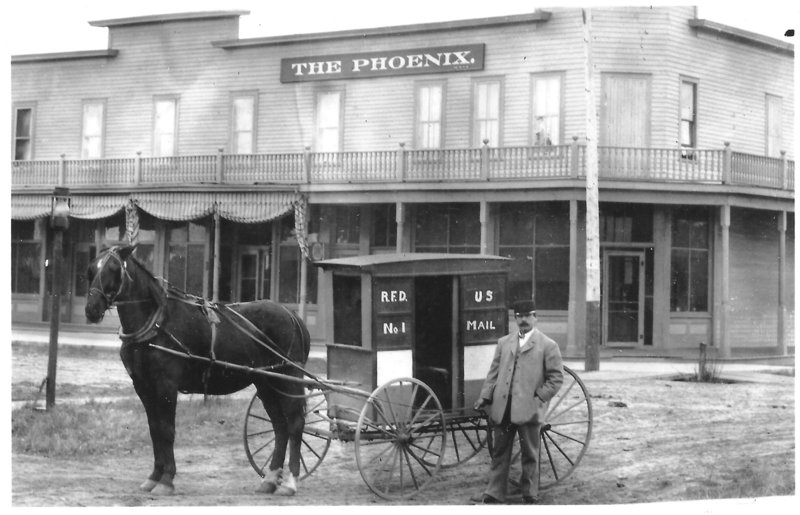
The Phoenix Hotel was built in Hinckley right after the 1894 fire. It was located on the northwest corner of Main Street. The man in the picture is U.S. Mail carrier Baptiste Rolle.

Sunday, April 21, 2013

Name that Pine County Place #2

Where in Pine County was the Phoenix located?  [Watch for the answer in a couple days!]

Sunday, April 7, 2013

The Penitentiary for Life

From the Pine County Pioneer, January 11, 1889: 

H.H. Scott will spend his remaining days in Stillwater for the Murder of S.K. Erwin. 

The jury brings in a verdict of murder in the second degree after being out seven hours. 

At the time of going to press last week Mrs. Scott was testifying on behalf of her husband. Her testimony was principally in relation to Mr. Scott's insanity. She told of an attempt he had made at one time to poison himself. Of another time when she was obliged to call in the Village Marshal to take a gun away from him, and of still another time when he pretended to shoot himself, and of similar acts which she as a physician, said were evidences of insanity. 

Doctors Paquin and Collins were called as medical experts on insanity and gave their opinion as to the mental condition of the defendant at the time of the homicide. In substance their testimony was to the effect that there were no indications of insanity. Several of the witnesses before sworn were placed upon the stand to substantiate some minor point, and the defense rested. The State then took the case, and recalled Mr. Rainsford who was in the round house at the time of the shooting and who saw the last shot fired. He swore that he was but sixty feet from the victim and that when Scott fired the last shot when standing over Erwin, he said, “I'll hang for it!” That the witness heard him say these words before turning to go away. The other testimony offered was of an unimportant nature, and the testimony was closed. A session was held in the evening when the argument of the attorneys was opened. Attorney General Clapp, for the State, spoke for about half an hour and after summing up the testimony in an able manner, touched on the importance of the punishment of such crimes. His argument was forcible and was not a disappointment to those who expected something above the ordinary. Mr. Johns, for the defense, occupied the attention of the jury for about an hour. He made an earnest plea to the jury, touching on all the important points and holding the jury as well as the large audience in wrapt attention by his earnest eloquence. For a man of his years, Mr. Johns may well be considered one of the brightest attorneys of the state. The case was submitted, but the Court did not charge the jury until the morning session. His charge clearly set forth the duty of the jury, and defined degrees of murder and manslaughter. It was clear, impartial and comprehensive. The jury retired at about 10:40 A.M., and it was not until within a few minutes of 6 P.M. that they agreed. When they slowly filed back into the Court room and took their seats in the jury box, the room was nearly depopulated, but it was but a few minutes before a small gathering assembled, and just as the bell was ringing for six, the Clerk read the verdict, finding the defendant guilty of murder in the second degree. After supper Court re-convened for the closing scenes of the trial. A death-life silence prevailed when the judge called the court to order and ordered Mr. Scott to stand up. When asked if he had anything to say “why the sentence of the law should not be passed upon you,” Scott replied “Nothing, but that I am innocent.” The Judge then sentenced Scott to confinement at hard labor in the state prison at Stillwater for the term of his natural life. When the sentence was passed Scott showed no signs of emotion, and went about the court room bidding his friends good-bye. He was taken to Stillwater on Monday. 

After the sentence was delivered Mr. Johns, for the defendant, gave notice of motion for a new trial, which will be heard before the judge.

Monday, April 1, 2013

Guilty or Not Guilty

From the Pine County Pioneer, January 4, 1889: 

A Synopsis of the Trial of H.H. Scott for the Murder of Sidney K. Erwin 

The trial of H.H. Scott for the murder of Sidney K. Erwin, which is now occupying the attention of the District Court, is one of the first cases of the kind ever held in the county, and is attracting a great deal of attention. 

The circumstances attending the killing of Sidney K. Erwin at Hinckley, in this county, on the 22nd day of Nov. 1888, (a full account of which has been previously given in these columns) are still too fresh in the minds of our readers. That H.H. Scott was arrested for the crime, waived examination before the magistrate, and that the grand jury found an indictment for murder in the first degree, are also well known facts. 

Court convened Wednesday, the 2nd inst., with Judge Crosby presiding, County Attorney, L.H. McKusick assisted by Attorney General Moses E. Clapp conducting the prosecution, while Henry Johns of St. Paul appears for the defense. The selection of a jury occupied Wednesday and Thursday afternoon and it was not until the fourth special venue had been exhausted that the twelve men charged with the awful duty of passing upon the guilt or innocence of a former neighbor, charged with the most horrible of crimes. The jury as completed consists of the following: Frank Cort, Jos. Bircher, Chas. Stephan, P. Buckley, John McGann, Albert Glasow, John Neville, Henry Kruse, J.C. Miller, John Bertsche, W.H. Russell and R.G. Robinson. 

It was not until the evening session Thursday that the matters had been arranged and County Attorney L.H. McKusick arose and opened the case on behalf of the State. After stating the indictment found by the Grand Jury, Mr. McKusick spoke briefly of the duties and responsibilities of a juror in the case, which he said was even more arduous than were those imposed upon him as the prosecuting attorney. He touched upon the relations formerly existing between the defendant and the jurors, and argued the jurors to the discharge of their duties without fear and in an impartial manner. The testimony was then taken up. 

Dr. C.O. Paquin was called and testified in relation to the state of Erwin's body, the wounds found etc., all of which has been previously given. Upon a cross examination by Mr. Johns, the Dr. stated that there were signs of powder burning on the outer garments of the victim, proving that the revolver was in close range. 

Dr. Collins of Minneapolis, who with Dr. Paquin conducted the post mortem examination was next sworn. He testified to the course of the bullet, corroborating Dr. Paquin. A bullet was introduced and identified as the one taken from the body of Erwin. On cross examination the same facts in relation to powder burning were brought out. 

George W. Booth being called testified to having arrested Scott and taking a revolver from him, which was introduced, identified and offered in evidence. When taken from Scott three chambers gave evidence of having been recently discharged. 

Chris. Severtson who lives in Chisago county, but was on boarding car on the St. P. & D., track at the time of shooting said he heard two shots fired which sounded in the direction of the pump house, went to the door and saw a man shoot one shot. The man who shot was standing at the head of the man laying on the ground, whom he afterwards learned was Erwin. Did not know Scott and was not sure the defendant was the man. 

A diagram was introduced in court by the prosecution giving the position of the dead body, the pump house, boarding car, round house etc., and H.J. Rath was recalled to identify the plat. He said he made it at the instruction of the Co. Attorney, and that it was correct. Geo. W. Booth was also recalled and stated that he was present when the plat was made and testified to its correctness. 

Bartlett Knudson who was cooking in the boarding cars near the scene on the day of the murder knew Scott by sight. Saw Erwin at pump house. Heard shots and went to the door. Saw a man and woman going up track, and described the directions in which they went. Went to where the body laid. Erwin was not yet dead, and tried to raise his head after he arrived, but could not. Did not notice any of surroundings. 

F.D. Rainsford said he was in the pump house when Scott and wife came to door; went to round house opposite. Heard two pistol shots which seemed to come from pump house. Looked out of window and saw Scott standing at Erwin's head, revolver in hand. After he saw the shot fired went out of front door of the round house and could not tell the direction Scott went. He also described the position of the body. 

A recess was then taken until Friday morning, when Geo. W. Booth again took the stand testifying in relation to the circumstances attendant on Scott's arrest, the delivery of the revolver to him etc., and subsequently identified the clothes taken from Erwin and which had been in the custody of the Sheriff. No other important witnesses were examined by the State. 

The defendant's case was opened by Mr. Johns in one of the strongest and most forcible addresses that has ever been delivered at the Pine County bar. 

Sam. Norton, of Hinckley, was the first witness sworn by the defense. His testimony was in relation to his conversation with Scott after the killing. He described the condition Mr. Scott was in, and told of his meeting him, etc., all of which is familiar to the public. 

H.H. Scott, the defendant, was next placed on the stand. He gave an account of the tragedy, which in every particular resembles the interview with the prisoner, which we published the day after. He said he had no intention of shooting Erwin when he went down to the pump house, that the first difficulty he had with Erwin was in August when he forbade his coming to the house. We have not time nor space to rehearse the scene of the tragedy as described by Mr. Scott, and which has previously been given in full. His story was told in a frank open manner, and cross questioning failed to tangle him. 

Geo. W. Booth was the next witness called, and testified to having been called in by Mrs. Scott a number of times to quiet Mr. Scott. At one time he was called in to take a gun away from him. This was more than a year before. Mr. Scott's son was drowned. 

He also spoke of several other times he had been called in, thought Scott's bad behavior was due to intoxication. 

Harry Parker was sworn, but no testimony of any importance was elicited. 

E. Veenhoven, Judge of Probate, testified that Mrs. Scott had in the year 1887 made an informal request of him for an examination into Scott's mental condition but as no information, as is by law required, was made, nothing further was done. 

As we were obliged to close our forms early in the afternoon, none of the evidence submitted after noon could be included. As we go to press, the defense occupies the court. If an evening session is held, the case will doubtless be completed tomorrow (Saturday).